
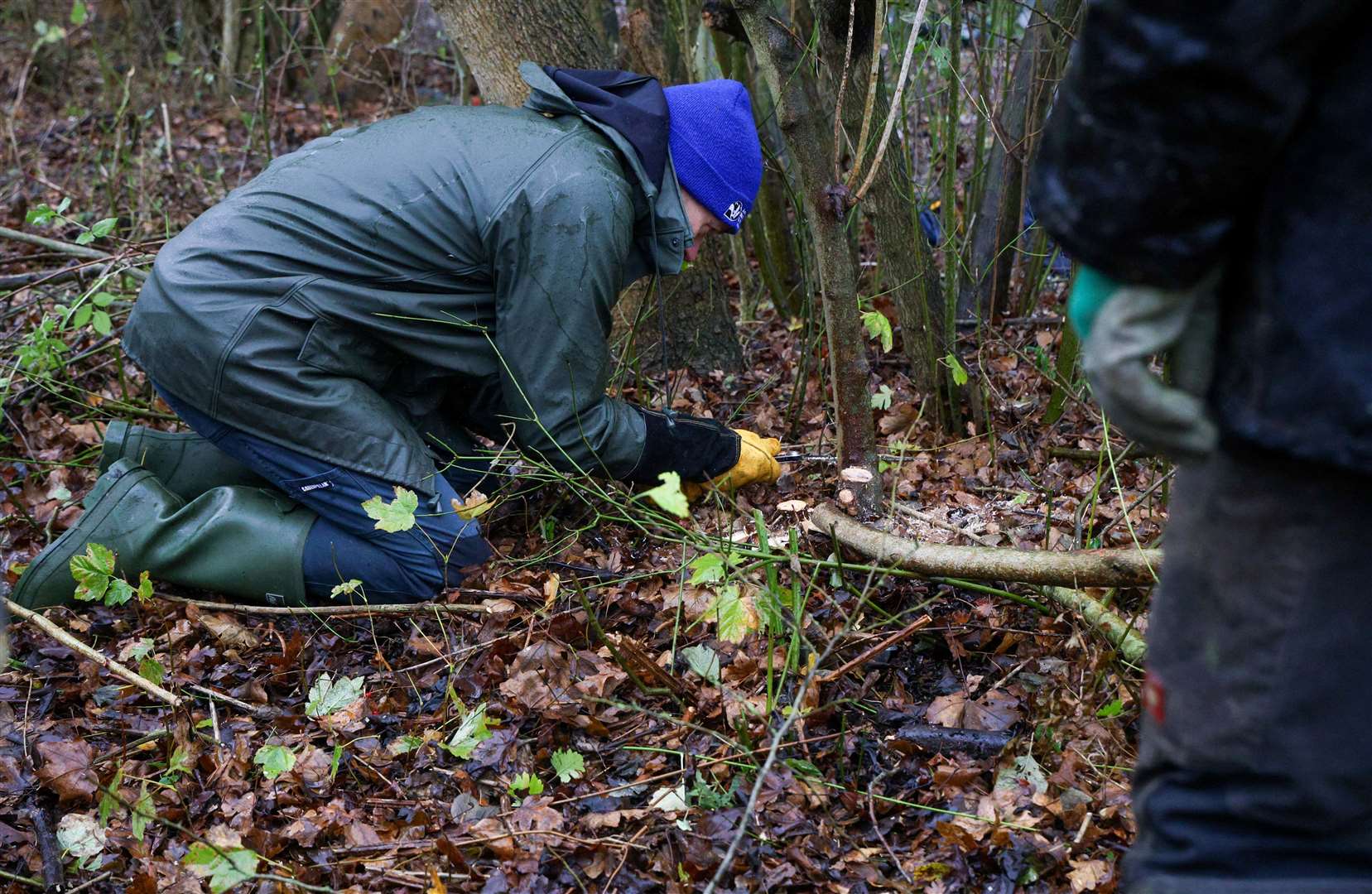
Green-fingered volunteers try their hand at hedge-laying
Residents have been hedge laying at the Bee Ark in Newbury at the weekend with a local conservation group.
The free event saw both adults and children learn about the history of hedge laying, why it is important, and how to do it.
Volunteers gathered at the Bee Ark (just north of the Monkey Bridge footbridge in Northcroft) for their free rural workshops.

The group of volunteers split into smaller groups and had a go at prepping, pruning and bounding the hedge in the typical Berkshire style – which is characterised by its ‘double brush’.
This means that the brush (smaller, dense branches) are left on both sides of the finished hedge which can be between 80cm and 120cm wide.
The brush should ideally fill each side of the hedge fully down to the ground, covering the base of the cut stems to stop animals being able to browse new growth in the following spring.


“Hedge-laying is one of the most cost effective things we can do to enhance biodiversity.” explains Richard Harrison founder of Newbury-based conservation group Newt, who led the course.
“As well as providing the perfect environment for nesting birds, a laid hedge has so much more density lower down, so better supports vulnerable floor dwelling creatures,” he said.
“Where we have laid hedges in the past, we have seen a significant uptick in hedgehogs, shrews and mice.
“It was a good turnout, everyone said it was fun and they enjoyed it.”


The workshops answered questions such as what trees to use, how to get permission on public land when a hedge is ready to lay, and how to do a risk assessment.
Following the hedge-laying workshops there were also natural fences built by volunteers on the weekend using chestnut posts and material generated from the hedge-laying course.
Mr Harrison said: “They both look very fitting alongside each other, they compliment one another very well.
“It will especially look great in summer.”


The Bee Ark’s Polly Pereira and Clare Kendall are helping build the fences around the beds that had been washed away by flooding previously.
“During the winter of 2023/24 the beds sustained severe and prolonged flooding,” said Ms Pereira. “One of the many casualties of this was our natural fencing which encircled each of our beds. They were, quite literally, swept away.
“We decided to take advantage of the large amount of natural material which will be generated by the hedge-laying course and hold a workshop to rebuild them.
“This time we used long-lasting chestnut stakes and leaving a gap at the base of the fence to make it more flood resilient.”